|
|
| Home / |
| Membrane filtration is a physical liquid separation process.
The basic facility is being able to cold process without any thermal energy. Thanks to this facility, it requires much less energy than evaporation, crystallization and other thermal process applications. Also it prevents a separation or concentration without any damage on physical aspects of heat sensitive products.
Membrane filtration is common used for dairy, food, chemi, pharma and biotechnological areas.
It is possible to seperate selective permeable substance or some mixtures depending on type of membrane.
Most important technical applications according to membrane variations are; reverse osmosis, nano filtration, ultra filtration and micro filtration.
|
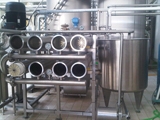 |
| Reverse Osmosis |
| It is a water separation and purification process by forcing the product into a semipermeable membrane with help of osmotic pressure. |
|
|
|
| |
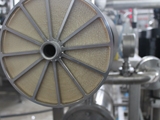 |
| Microfiltration |
| Microfiltration (commonly abbreviated to MF) is a type of physical filtration process where a contaminated fluid is passed through a special pore-sized membrane to separate microorganisms and suspended particles from process liquid. |
|
|
|
| |
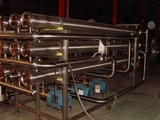 |
| Nanofiltration |
| Nanofiltration is a relatively recent membrane filtration process used most often with low total dissolved solids water such as surface water and fresh groundwater, with the purpose of softening (polyvalent cation removal) and removal of disinfection by-product precursors such as natural organic matter and synthetic organic matter. |
|
|
|
| |
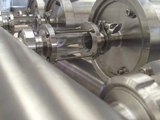 |
| Ultrafiltration |
| Ultrafiltration (UF) is a variety of membrane filtration in which forces like pressure or concentration gradients leads to a separation through a semipermeable membrane. |
|
|
|
| |
|
| |
|